
The journey to the digital world involved a long and complex process, with key milestones driven by talented individuals striving to innovate within specific social and economic contexts. The inventors of the Jacquard Loom and the Telegraph stand out pioneers of bringing us into the digital age we now find our selves in today. Their inventions serve as crucial examples of the and transmitting information, laying the groundwork for the both continental communication but for efficiency as well.
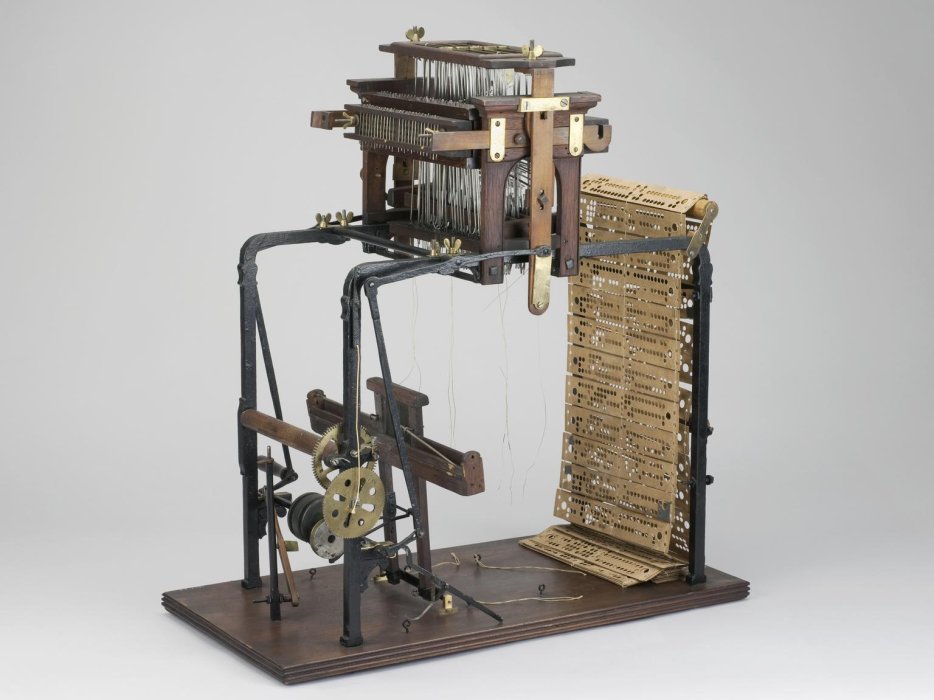
Joseph Marie Jacquard was a weaver in the French city of Lyon. It served as the center of wealth and innovation in the 18th century, home to a large silk weaving industry with over 14,000 looms, which required employing almost a third of the city’s inhabitants. The high demand for intricately woven silk fabrics, when the fastest method with two people to operate multiple pedals only resulted in producing a mere inch of fabric a day. Created the necessary economic pressure to find faster and more efficient production methods. Jacquard met these demands by building upon the work of others before him to develop his patented invention in 1804.
The Jacquard Loom was a revolutionary weaving machine for its time, with the use of punched cards it could be programmed to weave intricate patterns automatically. These punch cards contained holes or blank spaces, and as they were fed into the loom, they would selectively lower and lift the warp threads according to Grieves in the interior of the loom, recreating the desired pattern in silk. The arrangement of holes on the cards encoded the design. A single machine could now be programmed with different sets of punched cards to weave an almost limitless variety of patterns without any hardware alterations and now only required one person to operate it only needing to push one pedal to push cards into place.
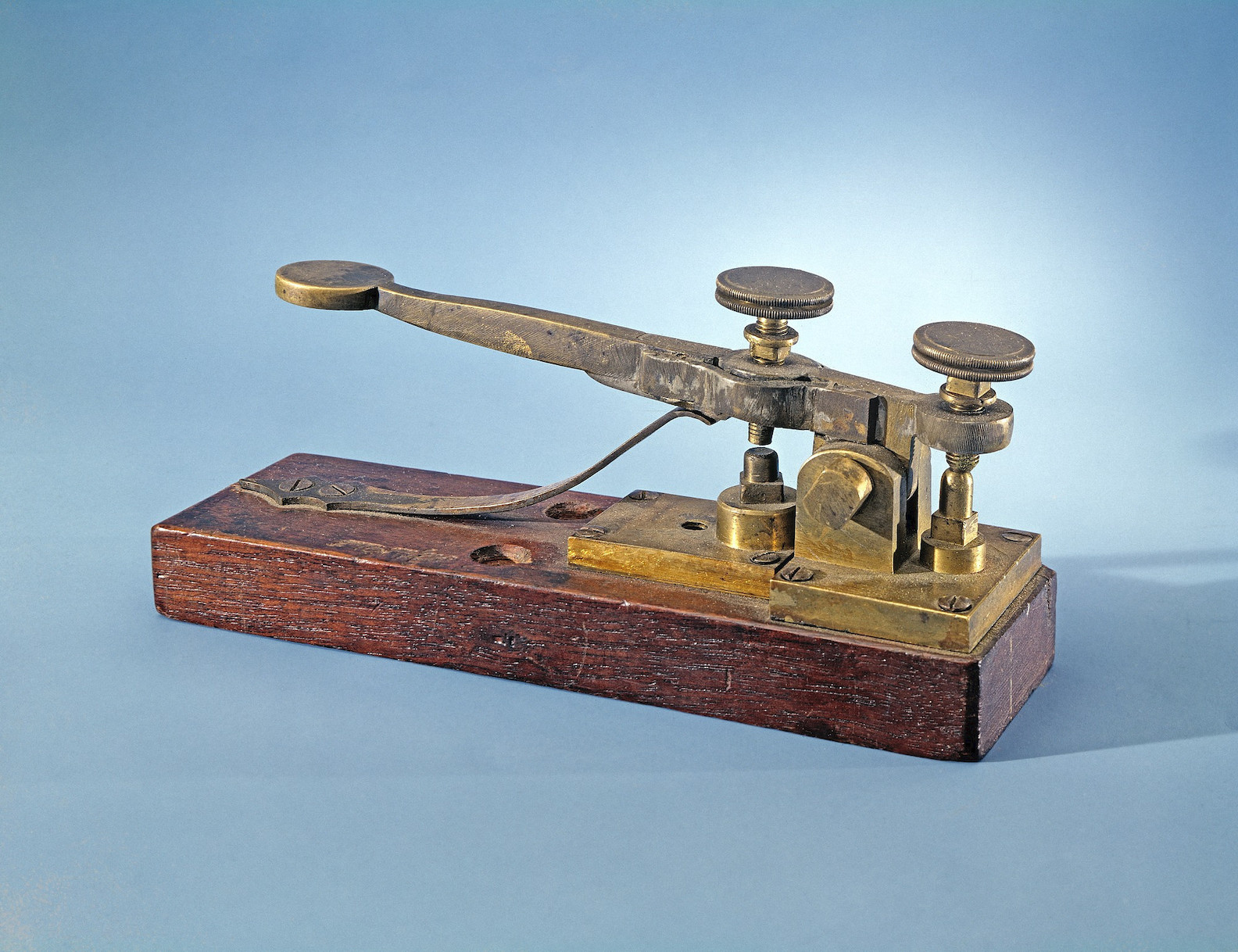
Similarly to Lyon in the 18th century, The 19th century was marked by the Industrial Revolution. Which saw a growing need for faster communication to support expanding businesses, infrastructure (like railways), and governance. The discovery and understanding of electricity provided the fundamental technical prerequisite for the development of the electric telegraph. Inventions such as the battery by Alessandro Volta served as key ingredients to communicate using electrical signals in a clear, conceise, and easy to understand manner. There had been many attempts to create the telegraph as the necessary requirements to create a similar device were available, but none of them ever reached the relevance or success that the Telegraph did.
This effort to create a easily understandable method of communication over electrical signals was created by Samuel Morse in 1838 with Morse Code. Morse code was a method of communication that involved using short and long pulses of electrical current to represent letters. Where one dot would represent a gap in time between the next signal, and a dash would be equivilant to three dots strung together. Letters that were more frequently used were given simpler codes, as they would be used more often in order to emphasize their ease of use and efficiency.
The inventors of the Jacquard Loom and the Telegraph represented pivotal moments in the evolution of information technology. Jacquard, Morse laid the crucial foundations for the digital world we inhabit today.