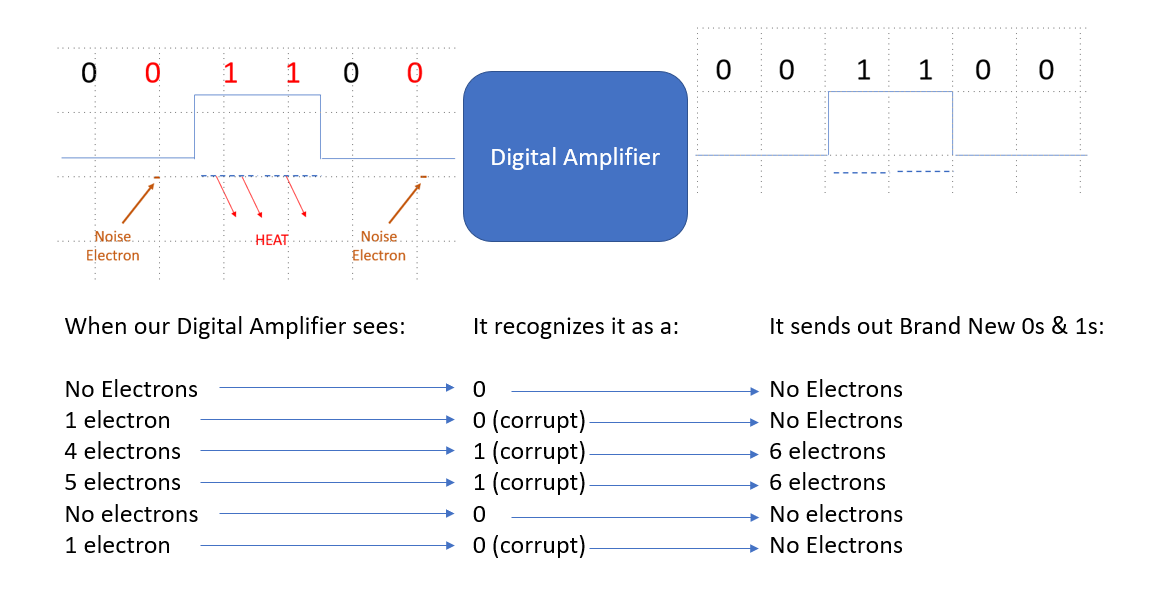
When digital signals were first introduced, they faced many noise issues, similar to those found in analog signals today. Early digital signals, represented as binary ones and zeros, struggled to filter out noise effectively. To address this, a new filtering method was created. If noise was detected, it would be replaced with either a one or a zero, depending on whether it was misinterpreted as one or the other. Due to this filtration method of reducing noise in a signal, this can allow for a multitude of things that require more precise signals. Devices that require percise signals to transmit data like debit cards in order to represent the exact amount of money you have remaining using percise signals, if a transaction were to have noise in that signal it wouldn’t be able to accurately tell how much money you would have left in your bank account, resulting in you having more or less money depending on a random chance of how the signal interprets a zero or a one.